News
How to Choose the Best Yacht Management Software in 2026: Why AI and MCP Matter
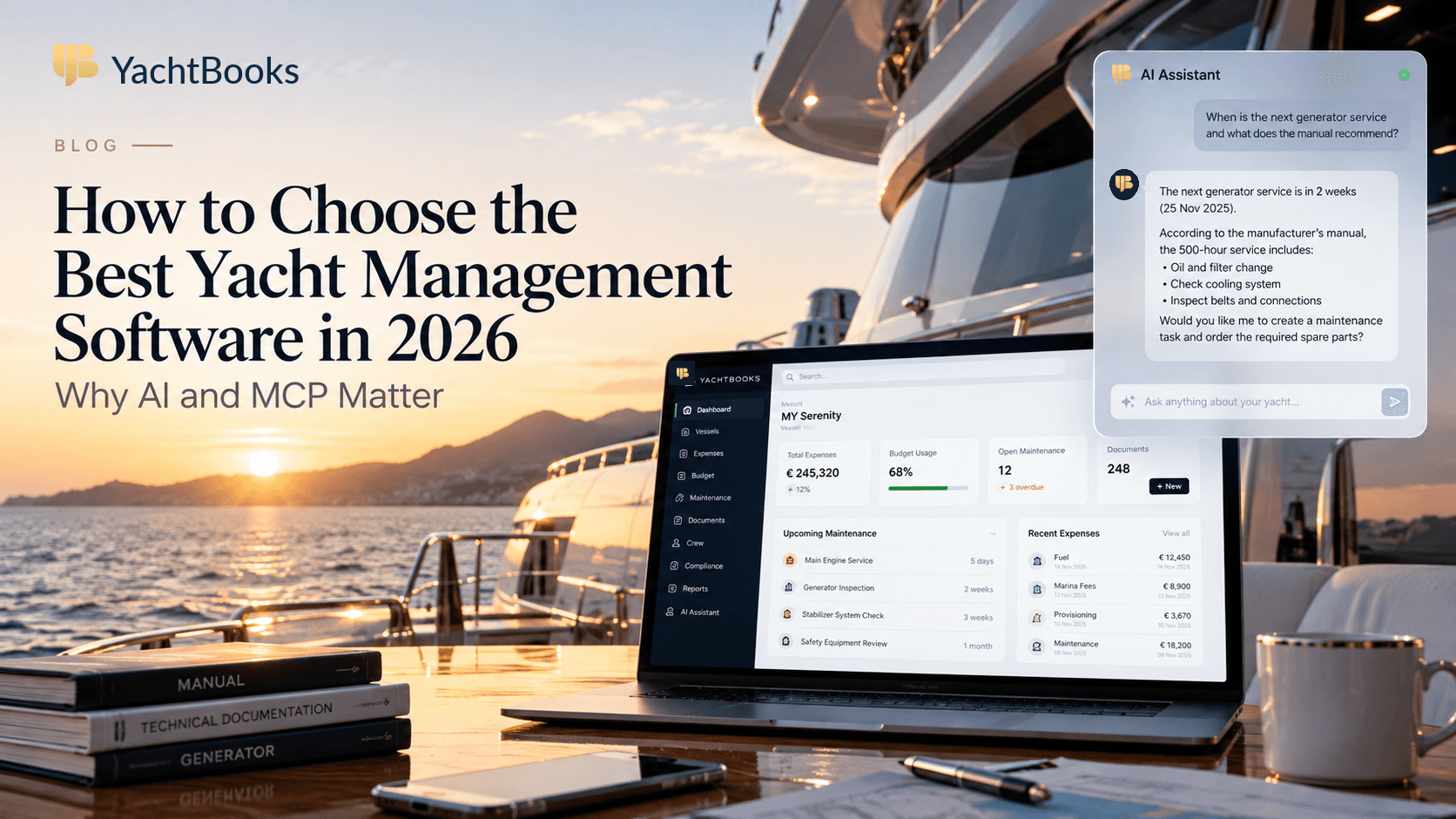
From planned maintenance and financial control to AI assistants and connected systems, yacht management technology is entering a new era.
Managing a superyacht involves far more than maintaining a vessel. Captains, chief engineers, yacht managers, owners and shore-based teams must coordinate maintenance, finances, crew, documentation and daily operations — often across multiple locations and currencies.
For years, yacht management software has helped organize this information. But organizing data is no longer enough.
The next generation of yacht management software is designed not only to store information, but to help people understand and use it.
Artificial intelligence (AI), integrated operational data and the Model Context Protocol (MCP) are changing how digital yacht management can work.
Here is what yacht owners, captains and management companies should consider when choosing a modern yacht management platform.
What Is AI-Powered Yacht Management Software?
AI-powered yacht management software combines traditional vessel management tools with artificial intelligence to help teams process information, access documentation and understand operational data.
A conventional yacht management system typically provides dashboards, records, schedules and reporting tools.
An AI-enabled platform adds another layer: the ability to interact with relevant information using natural language.
Instead of searching through multiple folders, reports or manuals, a crew member can ask a question and receive assistance based on the information available to the system.
For example:
What does the generator manual recommend for an oil change?
Where can I find the maintenance instructions for a particular onboard system?
Which expenses contributed to this month's maintenance costs?
How does actual spending compare with the approved annual budget?
These questions illustrate the value of combining AI with structured yacht data, maintenance records and technical documentation.
The goal is not to replace maritime professionals. It is to reduce the time spent searching for information so they can focus on operating the vessel.
1. An AI Assistant That Understands Yacht Documentation
A superyacht can contain thousands of pages of technical documentation covering engines, generators, navigation equipment, electrical systems, hydraulics and other onboard machinery.
Finding a particular instruction can be surprisingly time-consuming, especially when information is distributed across different manuals.
An AI assistant can make that documentation more accessible.
With YachtBooks, technical manuals and relevant documents can be uploaded to the platform and used by its AI assistant to help users find information and understand equipment-related questions.
Consider a chief engineer preparing generator maintenance.
Traditionally, the engineer might need to locate the correct manual, identify the model, search for the relevant service section and review the instructions.
With an AI-assisted workflow, the engineer can ask a specific question about the documented maintenance procedure.
The assistant can help locate and interpret the relevant information, while the engineer remains responsible for verifying the manufacturer's instructions and performing the work safely.
The important distinction is that AI should support technical expertise, not substitute for it.
2. Planned Maintenance Software: From Reactive Repairs to Preventive Planning
Planned Maintenance Systems (PMS) are essential for organized yacht operations.
A yacht PMS helps engineering teams schedule inspections, record completed work, track equipment history and prepare for upcoming maintenance.
However, maintenance planning becomes more valuable when it is connected to other operational information.
YachtBooks brings planned maintenance and financial management into a shared environment, with capabilities for:
Maintenance calendars, tasks and checklists
Equipment service history
Maintenance reminders
Supplier and spare-parts management
Maintenance costs linked to budgets and expenses
Imagine a generator service is approaching.
The maintenance system helps the crew identify the upcoming task. The relevant technical documentation is accessible through the platform, and associated costs can be tracked against the yacht's maintenance budget.
Rather than keeping the maintenance schedule, equipment manual and expense records in separate places, the team can work within a connected system.
This is where yacht maintenance software can evolve from a digital checklist into a more useful operational tool.
3. What Is MCP, and Why Does It Matter for Yacht Management?
One of the most interesting developments in business software is the Model Context Protocol (MCP).
MCP is an open standard that allows compatible AI applications to connect with external systems, data sources and tools.
In simple terms, MCP helps AI assistants work with information outside their own conversations.
For yacht management, this creates important possibilities.
A yacht management platform may already contain budgets, expense records, equipment information, maintenance schedules and vessel documents.
MCP-based connectivity creates a standardized way for compatible AI applications to interact with selected data and functions, provided the necessary integrations, permissions and security controls are configured.
How YachtBooks Uses MCP
YachtBooks incorporates MCP capabilities as part of its approach to connected, AI-enabled yacht management.
The platform is designed to work with AI technologies and external applications rather than limit users to a single isolated software environment.
This creates opportunities for connected workflows involving yacht operations, financial information and AI assistants.
For example, a management team might want a compatible AI assistant to help answer questions such as:
What is the maintenance status of a particular vessel?
Which spending categories are above budget?
What information is available about an upcoming service?
How can operational reports be prepared using authorized vessel data?
The specific functionality depends on the connected modules, available MCP tools and configured user permissions.
MCP is not itself an AI model. It is a connectivity standard that helps applications and AI systems exchange relevant information and capabilities.
That distinction matters when evaluating software providers.
The future is not necessarily one AI assistant doing everything. It is a connected environment where different systems can work together securely.
Learn more about the standard through the official Model Context Protocol documentation.
4. AI and Yacht Financial Management: Turning Expenses Into Insights
Financial transparency is a major consideration in superyacht operations.
Fuel, maintenance, provisioning, marina fees, crew-related expenses and unexpected repairs can all affect a vessel's annual budget.
When information is scattered across spreadsheets, emails and bank statements, producing an accurate financial picture becomes more difficult.
Modern yacht accounting and expense management software should help teams answer three fundamental questions:
What was planned? What was spent? What needs attention?
YachtBooks brings together financial tools including annual budgeting, multi-currency expense tracking, bank integration, invoice processing and reporting.
Its OCR and AI-assisted invoice processing capabilities help extract information from photographed receipts and invoices, reducing repetitive manual data entry.
Meanwhile, budget-to-actual comparisons allow authorized users to identify differences between planned and recorded spending.
AI-assisted summaries can make financial information easier to interpret.
A yacht owner may be interested in the overall financial picture, while a captain needs visibility into operational spending and a management company needs reporting across multiple vessels.
Each role benefits from access to information relevant to its responsibilities.
5. Why Connected Data Matters for Superyacht Fleet Management
Managing one yacht is complex. Managing an entire fleet introduces another level of coordination.
A yacht management company may need to oversee different captains, engineering teams, currencies, financial approval processes and maintenance schedules.
If every vessel uses a separate combination of spreadsheets and applications, consolidating information can become an administrative burden.
An integrated yacht management platform creates a more consistent operational structure.
With YachtBooks, organizations can manage information across individual vessels and fleets, while role-based access controls help determine who can access different records.
The objective is straightforward: allow vessel teams to handle their daily work while providing shore-based management with broader visibility.
AI and connectivity standards such as MCP can build on this structured foundation, making information easier to work with across compatible applications.
6. Data Security and Human Control Still Come First
Introducing AI into yacht management raises important questions about confidentiality, financial authorization and operational control.
Superyacht information can include sensitive details about vessel operations, crew, financial transactions and technical systems.
For that reason, buyers should evaluate more than an AI assistant's ability to produce answers.
They should ask:
Who can access vessel-specific financial and operational data?
How are permissions managed across owners, captains and crew?
Which information can be accessed through external integrations?
What controls apply before an AI-enabled system performs an action?
How are confidential documents protected?
MCP connectivity does not automatically mean that all information becomes public or accessible to every AI application. Actual access depends on how each integration is implemented and authorized.
YachtBooks uses role-based access controls as part of its platform.
The broader principle is that automation should improve efficiency without removing appropriate human oversight.
7. What to Look for When Choosing Yacht Management Software in 2026
Before selecting a platform, yacht owners and management companies should evaluate how well it supports their real operational requirements.
Consider these areas:
Integrated financial management: Can users manage budgets, expenses, approvals and multi-currency reporting without relying on disconnected spreadsheets?
Planned maintenance: Does the platform help crews schedule work, maintain service histories and track maintenance-related expenses?
AI-assisted information access: Can crew members use AI to work with relevant technical documentation and operational information?
Interoperability: Does the software support suitable APIs, integrations or standards such as MCP to reduce dependence on isolated systems?
Fleet scalability: Can the system accommodate multiple vessels, users, roles and management structures?
Security and permissions: Can sensitive information be protected according to each user's responsibilities?
Practical usability: Can captains and crew complete everyday tasks without unnecessary administrative complexity?
The best yacht management software is not necessarily the platform with the longest feature list.
It is the platform that fits the vessel's operational needs, reduces duplicated work and helps teams make informed decisions.
YachtBooks: Connecting Yacht Operations, AI and Financial Clarity
YachtBooks is a yacht management platform developed for superyachts, yacht owners, captains and management companies.
It combines financial and operational management capabilities, including budgeting, expense tracking, planned maintenance, crew management, documentation and connected banking services.
The platform also incorporates AI-assisted capabilities and MCP connectivity as part of its approach to modern yacht operations.
Rather than treating AI as a standalone feature, YachtBooks is built around a broader principle:
Technology should make complex yacht operations easier to understand and manage.
For yacht owners, this means better visibility.
For captains and crew, it means spending less time navigating administrative processes.
For management companies, it means a more connected way to oversee multiple vessels.
The objective is not simply to digitalize paperwork. It is to make operational information more useful.
Frequently Asked Questions
What is the best AI-powered yacht management software?
The best AI-powered yacht management software depends on the vessel's requirements. Buyers should evaluate budgeting, expense tracking, planned maintenance, technical documentation, integration capabilities, security and everyday usability. YachtBooks is one option for teams seeking integrated financial and operational tools with AI-assisted capabilities and MCP connectivity.
Can AI help with yacht planned maintenance?
Yes. AI can assist with searching technical manuals, understanding documented service procedures and finding relevant equipment information. A dedicated PMS remains important for maintenance schedules, work records, reminders and service history. Technical decisions and safety-critical work should remain under qualified human supervision.
What is MCP in yacht management software?
MCP stands for Model Context Protocol. It is an open standard that enables compatible AI applications to connect with external data and tools. In yacht management, MCP can support connections between AI assistants and authorized vessel management information, depending on the platform's implementation and permissions.
Can YachtBooks manage multiple yachts?
Yes. YachtBooks is designed to support individual yachts and multi-vessel operations, including financial reporting, operational records and role-based access.
Does YachtBooks support AI and bank integrations?
YachtBooks includes AI-assisted document and invoice processing, an AI assistant for relevant uploaded documentation, MCP capabilities and bank integration functionality. The availability and scope of individual integrations should be confirmed for the relevant account and service providers.
The Future of Yacht Management Is Connected
Superyacht operations will always depend on experienced captains, engineers, crew and management professionals.
What technology can change is how efficiently those professionals access information and coordinate their work.
AI makes information easier to explore. PMS tools help organize maintenance. Financial systems provide clearer reporting. Open connectivity standards such as MCP create new opportunities for applications to work together.
The most valuable innovation is not technology for its own sake.
It is giving the right people the right information when they need it.
Discover a more connected approach to superyacht management.
Explore YachtBooks and request a demo.
YachtBooks — Luxury Yacht Management. Simplified.